A complete survey of my HDB carpark
In a moment of madness, I decided to do a survey of the cars in my carpark. My main intention is to see how many cars have switched to OBU and how many opted for the display.
I have done such a survey once in ~2013. My intention then was to get the age distribution of cars and how many were PHVs. I only recorded the letter part of the car plate number. I immediately found it was not fine enough — I should have recorded the first digit as well.
I could not find the data anymore. :-(
This time, I decided to be more comprehensive as well. To collect:
- Car plate up to first digit
- Car make
- Car type: PHV, Taxi, OPC, EV or Hybrid
- OBU or IU
- Has display or not and display position
Type of cars:
|No. of cars|231|
|EV|17|
|Hybrid|4|
|PHV|26|
|Taxi|6|
|OPC|3|
(Hybrids may be undercounted.)
There are currently 7 charging lots in my carpark (4 from BlueSg). The carpark is also being upgraded for higher charging capacity. It is not known if more lots will be added.
Standard HDB carpark chargers are only 7.4 kW. LTA says it takes 3.5 hours to charge 100 km worth of mileage for a typical EV. This is super slow! Not sure if they can be upgraded to 22 kW (3-phase power).
Top brands:
|Toyota|23.4%|
|Honda|22.5%|
|Hyundai|6.9%|
|Mazda|6.1%|
|Nissan|6.1%|
|Mercedes|6.1%|
|Kia|5.6%|
|BYD|5.2%|
|BMW|3.9%|
This is expected to change in coming years as more drivers opt for EV. Nissan is higher than expected because vans are included.
Type of ERP device:
|OBU|218|
|IU v1|1|
|IU v2|12|
Most have changed: 94.4%, inline with island-wide average. I'm surprised there is one car using IU v1.
OBU with display or not:
w/ display|188|
non-default pos|9|
w/o display|21|
There was widespread negative feedback in the beginning, but in the end most still opted to install it in the default position.
On data collection
I need to improve the way I collect the data. It took me almost 1.5 hours to record all the data. I took longer for some cars because I needed to figure out the brand and type (EV or not).
Maybe the next time I do it, I'll just record a video as I walk through the carpark, then play back the video at my own leisure. This should give me all the data except for OBU — it may be difficult to make out the OBU due to dim lighting and windscreen tint.
I doubt I'll do it any time soon, though. :lol:
IU to OBU
I received my second reminder to install OBU in early Feb. I had three months left to do it for free.
Then, LTA announced that OBU is mandatory for all cars (except those on Classic/Vintage scheme) from 1/1/2027 and that free installation is offered up to mid-May only. I went to book an installation date immediately. I didn't want to get caught up in last minute jam — installation dates can be several months out.
(Over 93% of vehicles (~930k) have installed OBU as of 31/1/2026. Last report was 65% (~650k) in Aug 2025.)
I had the impression my regular workshop do OBU installation. They don't. Panic. I started to look for one. I wanted to use an authorized workshop as they would be more flexible compared to authorized centres such as Vicom. I prefer somewhere near my office so that I can do it during working hours. The first one I called, they didn't handle my car. I looked around some more. Second one, bingo! I asked for an April appointment, but they were not taking April appointments yet, the latest date I could book was end-March. I didn't want to put it off, in case I forgot, so end-March it was.
Old vs new look:
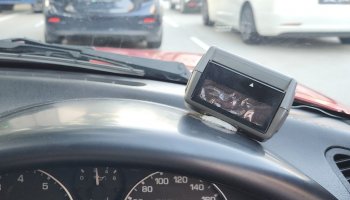
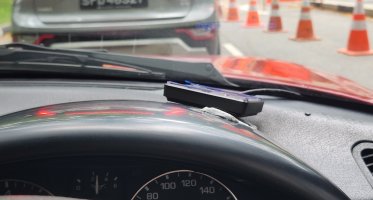
My IU was placed on the dashboard — it fell off the windscreen many years ago and it still worked, so I didn't bother to put it back — so I want to put the antenna unit on the dashboard as well. Preliminary result: it works flawlessly!
I wonder if it works if it is turned around.
I notice that some vans/lorries have vertical windscreen, so the antenna unit is mounted vertically, and it still works, so there should be some flexibility in placement.
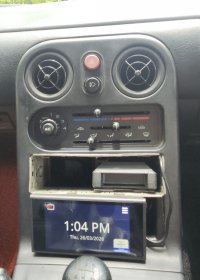
I'm happy the main unit can be installed in the console cavity where the radio unit used to be.
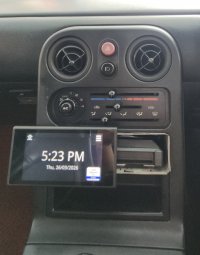
After some fiddling, I found that the display unit can be placed in the console cavity as well. It is held in place by its stand — just long enough! — from the other end. It is quite secure, but it can be pulled off with a little force — and it takes some effort to put back properly.
The cashcard slot is blocked. Need to rotate the display unit to insert cashcard. :lol:
I'm pretty happy with the OBU installation. I achieved all my objectives:
- Antenna unit is placed on dashboard
- Main unit does not take up any space in the cabin
- Display unit does not block the front view and is detachable
Thoughts on the display unit
For my car which has a barebone console, a display brings it into the 21st century! :lol:
Modern cars already have their own display that can display the same things, so it is redundant.
The info it displays now (speed camera zone, school zone, silver zone, bus lane, road works, est time on expressways) are nice-to-have, but not really essential. Waiting for its killer app: distance-based charging. :-D
It helps that it is not placed at the windscreen and blocking the front view. I would have felt very differently.
Air quality monitor, take 2
My 8-in-1 Air Quality Monitors, all four of them, suddenly show 0 for PM 2.5. Surely the sensors can't all fail at the same time?
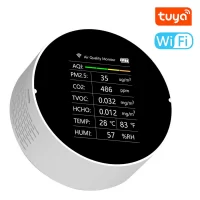
I found this, a 7-in-1 Air Quality Detector. It has: AQI, PM2.5, CO2, TVOC, HCHO, Temperature and Humidity. (Is AQI a reading?) :hmm:
The battery is 1200 mAh, it will last a few hours at most. My current one is 800 mAh and lasts around 4 hours.
Hopefully it is more reliable than my current monitors.
I also hope it is less chatty. The current ones update Tuya Cloud every 60s. This isn't too bad, except they also update when there is a change. It is especially bad for temperature and humidity, which are only accurate to whole numbers. When humidity is, say, at 59.9% to 60.0%, it will keep switching between 59% and 60%. It can happen as fast as 1.4s. It should limit the update to once every 60s.
Dominion game update pack

Dominion update pack
I'm surprised it is still available after so long (released in 2016), and at MSRP somemore.
I have the first edition of the base game, no expansions. The update pack replaces 6 existing cards with 7 new ones. This is important as the original 6 cards are proven to be 'useless' over the years as people gain experience with playing the game, so people don't play with them anymore.
This is enough Dominion for me. :lol:
Richard Feynman AI lectures
I recently noticed there are many Richard Feynman lectures 'brought to life' using AI. They use his voice and imagery. Some use static picture, but many show him talking — animated through the wonder of AI.
The topics are his signature physics stuff, but also non-physics stuff I'm not sure he ever talked about in his life.
I learnt some new things.
First, we are moving forward in time at light speed. Space-time is like a plane. Imagine time as x-axis and space as y-axis. This is why time slows down when you move through space. If you move at light speed (vertical line), time stops.
Second, space is filled with fields. An EM wave propagates through an ever-present EM field. It reminds me of ether, but physicists refused to call it ether — because ether is a physical medium. I would call it New Ether. :lol:
Gravity is the curvature of space due to mass. EM field is curved along with space, so the EM wave follows the curved path.
Third, light wave-particle duality. Light behaves like wave. However, it has been proven to be made up of particles, called photon.
The only problem is the double slit experiment. It shows interference pattern, so light behaves like a wave. If we fire one photon at a time, it still builds up an interference pattern over time, implying a single particle interferes with itself?! It makes no sense. The funny thing is, if we try to observe which path it takes, the interference pattern disappears and it acts like a particle (two distinct bands).
I came to a realization after listening about it and EM waves. A photon is the smallest unit of EM radiation. This is why we say light is packetized. However, it travels as a wave — the energy of a single unit is spread out as a tiny wave. It enters both slits and hence can interfere with itself. When we observe it, we energize one part of it and hence it is no longer be interfered by the other part.
We are trapped by the word 'particle' to think it is an indivisible point. Once we abandon the thinking, it becomes crystal clear. This is the essence of Richard Feynman's teaching.
This can explain so much at sub-atomic level.
Why is there quantum entanglement? Why is there quantum tunneling? They are due to the same principle.
This also helped me to get past the hurdle on how an electron 'orbits' the nucleus. Do they really orbit? No, they exist as standing waves around the nucleus — this is elementary Quantum physics. Wave. It is all waves! When we make an observation (which is destructive), what we think is the particle is the absolute maxima.
Ageing condo lift bail out
Headlines after public outcry: Ageing condos will not get public funds for lift maintenance, renovation and redecoration works: BCA
But the contents says:
It reiterated that any government co-funding will be targeted at safety upgrades for older lifts, to add safety features that were not available when they were installed.
These include systems to prevent lifts from moving unless the doors are fully closed and secured, or to automatically stop them if they move upwards too quickly.
After 30 years, anything can be categorized as 'safety issue'.
Lift replacement is one of those decade long events that you don't consider and it comes back to bite you.
Worse is if a condo is planning/trying to enbloc and does minimal maintenance, and now expects a free upgrade? That's the worst kind of selfishness.
Some people say if the Government can fund coffeeshop toilets upgrading, it can fund private condo lift upgrading as well. No, coffeeshop toilets are still open to public. A better analogy would be restaurant/mall toilets.
The Government can fund lift upgrades, but it cannot be free. It should either be a loan or to clawback when a unit is sold or the condo is enbloc'ed.
Puerto Rico game HK Classic (2015) vs Deluxe (2021)
波多黎各 經典版 vs 豪華版.

Classic on the left, Deluxe on the right. The printing on Deluxe is too contrasty/dark — almost like a KO! The cards have linen finish, which I dislike.
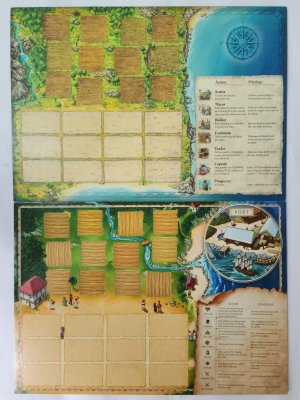
Classic on top, Deluxe at bottom. Both are fine, but Deluxe looks 'sharper' with well-defined outlines.

The reddish brown market board of Classic is its one sore point. It is too hard to read! Deluxe wins hands down.
Classic is dual-sided. The other side is for base game, the other side is for expansions (more buildings). As a result, it is bilingual on both sides. The English text is very small.
Deluxe uses the same board for base game and expansion. The extra buildings are in a different color. It is Chinese on one side and English on the other. The English text is normal size.
Small World KS
Thinking about Terraforming Mars Big Box makes me remember Small World Designer Edition from 2013. (It was shipped in late 2014.)

This is of course a top-of-the-range deluxe set with wooden tokens, metal coins and a BIG wooden box. It costed US$320.
It made an impression on me then. I wanted to pimp out my games (not that I have this game), but this was very expensive.
How many copies were sold? It was never revealed.
We can't tell from the Kickstarter because it was not part of any standard pledges — you top up your pledge by US$320 to get it.
We can estimate.
|Pledge|$|#||
|---|---|---|---|
|Kobolds|$1|469|$469|
|Tritons|$8|864|$6,912|
|Skeletons|$15|3,328|$49,920|
|Goblins|$40|1,202|$48,080|
|Orcs|$60|1,163|$69,780|
|Spiderines|$600|6|$3,600|
|---|---|---|---|
|Total|||$178,761|
The KS raised $394,019 (very little by today's standards) from 7,044 backers.
The extra $215,258 must have gone to one of the extras (races $5, t-shirt $21, game $320).
Assuming they all go to the game (local; overseas +$50), it works out to be 672 units.
I'll say there are around 600 copies.
Terraforming Mars KS
Puerto Rico Special Edition reminds me of another Kickstarter that I missed: Terraforming Mars Big Box in 2021. It raised $2.765 mil from 23,419 backers.

IIRC, I did not miss it, but I gave it a pass for two reasons: I did not have the game — though I was always semi-interested in it — and it was too expensive. It was beautiful, though.
The Big Box was a big box to store the base game and all expansions. However, the Kickstarter was really all about bling: 3D tiles, metal cubes, player boards, card sleeves and so on.
The Box itself was decent value, but add-ons were expensive.
Prices:
- Big Box (including 3D terrain tiles): US$99
- Player boards: +US$20
- Rover mini (first player model): +US$10
- City domes: +US$15
- Trade fleets: +US$10
- Metal cubes: +US$60
- Card sleeves: +US$50
Metal cubes and card sleeves were especially expensive.
Base game and expansions to be gotten separately. They were also available in the KS. In table form:
||Small Box|Big Box|New Recruit|Veteran|CEO|
|---|---|---|---|---|---|
|Game|-|-|Y|-|Y|
|Expansions|-|-|-|Y|Y|
|Promos|Y|Y|Y|Y|Y|
|Big Box|-|Y|Y|Y|Y|
|3D tiles|Y|Y|Y|Y|Y|
|---|---|---|---|---|---|
|Price|$79|$99|$144|$179|$224|
The base game itself has two long-time criticisms: the cards have poor/incohesive artwork (though some say is acquired taste) and bad player board (cubes are easily bumped, ruining game state).
Maybe I'll own Terraforming Mars one day. :lol:
Optics on 100% car loan at last
News: Concerns over 100 per cent borrowing for vehicles as outstanding car loans hit 12-year high
Car dealers are appearing in social media advertisements, promising buyers “$0 upfront” and “100 per cent loans” to secure their cars.
The ads, on Instagram and Facebook, promise buyers that they can skip the 30 per cent or 40 per cent down payment for a car through various schemes, including in-house loans.
One dealer even claimed to offer in-house loans with a 100 per cent guaranteed approval rate, without the need for any cash upfront.
These dealers, largely the smaller players in the industry, are taking advantage of loopholes in the regulatory environment, through inflated prices and in-house loans.
While licensed moneylenders and exempt moneylenders are regulated by the Ministry of Law (MinLaw) under the Moneylenders Act, and financial institutions are governed by the Monetary Authority of Singapore (MAS), lenders of in-house loans operate in an unregulated grey area.
In-house financing is effectively unsecured personal loans, Acting Transport Minister Jeffrey Siow previously warned.
Yio Chua Kang MP Yip Hong Weng told The Straits Times that if a financing arrangement effectively allows someone to pay for a vehicle over time in a way that mirrors a loan, then comparable consumer protection standards should be considered, regardless of how the contract is labelled.
“This ensures a level playing field and avoids regulatory loopholes.
“Clearer guidance on advertising claims, stronger disclosure requirements, and coordination across agencies would help ensure that protections remain robust,” said Mr Yip, who previously asked the Transport Ministry if it would review or enforce loan regulations to curb car dealers’ practice of offering 100 per cent financing packages
He added: “Access to financing should be responsible, transparent and sustainable.
“We should not normalise 100 per cent financing in a way that leaves families one unexpected setback away from financial stress.”
As for dealers offering 100 per cent loans by inflating prices to let buyers borrow more from financial institutions (FIs), INSEAD’s associate professor of finance Ben Charoenwong said both the buyer and seller may be committing fraud.
He added: “If the actual agreed price for a car is $120,000 but the dealer submits $170,000 to the bank, the bank’s 70 per cent loan-to-value (LTV) loan of $119,000 effectively covers the entire real price and the buyer puts almost nothing down.
“That’s not a creative financing structure. That’s deception.”
Calls to curb excessive borrowing and plug loopholes have been growing louder.
Sengkang GRC MP He Ting Ru similarly raised the issue in Parliament, asking if the Government is working with the Monetary Authority of Singapore to curb in-house financing that circumvents loan-to-value limits in the auto industry.
In a Feb 4 written response, Mr Siow said: “Buyers are strongly advised to obtain loans through regulated arrangements.
“The Government is monitoring the situation and will tighten regulations to manage the abuse of such regulations if necessary.”
The worries come as figures obtained by The Straits Times showed that households in Singapore had outstanding motor vehicle loans of around $12.4 billion by the end of 2025 – a 12-year high.
Said Mr Yip: “Motor vehicle loans form part of personal debt, and when outstanding balances rise to multi-year highs, it is not just an industry statistic but a signal about financial exposure among households.
“Easy financing can make cars appear more affordable than they truly are.”
Under MAS rules, financial institutions like banks must cap the loan amount given out at between 60 per cent and 70 per cent of the purchase price, depending on the vehicle’s open market value.
To check if full loans are being offered by car dealers with little restriction, ST posed as a would-be buyer of vehicles to investigate the prevalence of such options.
Of the five new and used car dealers ST reached out to, only one advised caution and encouraged prudence.
The rest said they could offer 100 per cent loans, either through in-house financing or by inflating the selling price. None of the authorised dealers, which tap financial institutions for loans, contacted by ST offered such borrowing schemes.
Proof of income
ST visited three companies on Feb 10 to inquire about the purchase of a new small car.
Two dealers immediately confirmed what their ads said – that they would submit a loan application to their in-house financers or partners for a loan covering the full cost of the car, which amounted to around $178,000 with certificate of entitlement.
One dealer said that for a car of that value, the buyer would be looking at a 10-year loan of around $2,000 in monthly instalments. Based on ST’s calculations, the total amount paid over the 10 years would be $240,000.
Buyers would need to show proof of a monthly income of at least $6,000.
The second dealer said a 100 per cent loan would be taken from the firm’s in-house financing unit.
The third dealer said that while it was possible to apply for a full loan for the car purchase, it would be more advisable to pay a 10 per cent down payment at least.
The dealer said this would be more financially prudent for someone earning a monthly income of around $6,000.
However, the dealer added that although it advised against it, it can use a long-held industry practice and inflate the price of the vehicle on paper when submitting the loan application to financial institutions or other loan providers.
“In the eyes of the finance companies, you are actually buying the car at a higher price, not the real price. So that they will loan you the original price amount,” said the dealer.
The buyer will still have to cover the goods and services tax incurred on the difference between the actual and inflated prices.
“(This is done) because we are generating an invoice, we are very law abiding... so we are very careful about compliance but we also try to fulfil our client’s needs,” the dealer added.
Another dealer said it offered the same inflated price scheme, but would absorb the additional GST due to an ongoing promotion.
A third scheme ST learnt about involved buyers claiming they are buying the vehicle to operate a private-hire car (PHC), in order to secure a 100 per cent loan.
PHCs, which are meant for commercial use, are exempted from MAS’ car financing rules.
Aware of practices
Experts said the authorities take a serious view of any attempt to circumvent motor-vehicle financing restrictions.
As for PHCs, ST understands that the Government is monitoring possible exploitation of the PHC exemption, where owners register private cars as private-hire cars with no intention of offering the service.
In a reply to ST, MAS sounded a note of caution over 100 per cent LTV loans, saying unregulated financing schemes carry higher risks, such as hidden charges and bigger losses for the borrowers if they default.
Its spokesperson added that the authority is also aware of the inflated-price practice used by some in the car industry.
“To counter mark-up practices, we expect FIs to conduct checks to assess if the purchase price is reasonable, such as by obtaining independent valuations.”
The spokesperson noted that the vast majority of borrowing for motor vehicle loans are taken with financial institutions regulated by the central bank.
“Other than MAS-regulated FIs, entities which are licensed or exempt moneylenders, or which offer financing in the form of hire-purchase arrangements, are also required to comply with the same motor-vehicle financing restrictions under the respective legislation or regulations,” the spokesperson said.
Prof Charoenwong said MAS could require FIs to independently verify car purchase prices by cross-referencing with LTA registration data, market valuation databases, or a standardised price guide, rather than relying solely on dealer-submitted invoices.
He added: “This is analogous to how mortgage lenders commission independent property valuations rather than taking the seller’s word for it. The technology and data exist; what’s needed is the regulatory expectation.”
Prof Charoenwong also said the Government could expand the Hire-Purchase Act or create a new licensing framework to capture lease-to-own and in-house financing arrangements.
“Agencies could mandate standardised disclosure of total borrowing costs, effective interest rates, and key risks for any motor-vehicle financing arrangement, similar to what regulated lenders must provide,” he added.
Prof Charoenwong said some dealers know that the bank’s loan officer has limited ability or incentive to challenge the stated price, especially when the deal superficially complies with LTV requirements.
So if the invoice says $170,000, that is what gets processed, he said.
“The brazenness – openly advertising 100 per cent financing and guaranteed approvals on social media – tells you exactly how dealers perceive the regulatory environment: they don’t fear consequences.
“That perception changes only when enforcement action actually materialises,” said Prof Charoenwong.
Authorised distributors contacted by ST said that they do not offer 100 per cent loans.
However, they do work with finance companies to extend private-hire car loans for ride-hailing drivers, which can be a higher amount than the standard hire-purchase loans for individuals.
The Singapore Vehicle Traders Association declined to comment when asked about the practice of dealers inflating their selling prices to get a higher loan amount for their customers.
Its spokesman said that being able to borrow more will make it easier to get a buyer.
The Hire Purchase, Finance and Leasing Association of Singapore, an industry body which keeps a register of vehicles that are financed by its members, said that it does not monitor the business practices of its members.
LTA is finally looking into practices that caused COE to be high. It is not like people are suddenly richer. It is because they are taking bigger loans.
I didn't expect some car dealers to be openly using 'overtrade', I thought this loophole was closed 15 years ago. No enforcement = no law.
It will be interesting if any new law is made retrospective and all illegal practices are fined or made to top-up (if you borrowed 100%, you have to cough up the missing 30% and pay down your loan).
They are not much individually (<$30k each), but they are sizable collectively. The Government went after 99-1 deals retrospectively cos the amounts were too large to ignore (>$200k each).
In summary, there are three ways to achieve 100% loan:
- In-house loan. Need new law to cover this
- Inflate price and get bank loan. Is fraud
- Loan under PHV scheme, car may or may not be PHV. If is PHV, is loophole. If is not PHV, is fraud
In-house loan has always been an oversight. It was negligible in the past, because who wants to pay high interest rate? And there were not many lenders too. But the need for car outweighs the need for prudence. Lenders saw an opportunity and jumped in because it was a "sure-win" loan. It is effectively a secured loan, but they get to charge personal loan interest rate.